[Marana, G.P.] Translator Hidde Grettinga
Literature Paris Turkey Spy story 1699 | Part 5 (of a series of 8): Brieven geschreven door een Turkse spion, hebbende 45 jaaren onbekend tot Parys geleefd en huys gehouden (…), Robert Blokland Amsterdam 1699, (6)+356+(11 register) pp.
Collection of fictional letters supposedly written by an Ottoman spy named Mahmut, who resided at the French Court of Louis XIV between 1637 and 1682, during which he reported all (political) novelties, gossip stories and events to Constantinople (Source: **Cf. Buisman 1538 (listing later editions). Navari, 1072: “Marana (…) was an Italian journalist long resident in France. He was the first to use the literary device of the ‘foreign observer’ which was developed later by Montesquieu and Goldsmith. Vols. II-VIII are not by Marana and were not translated from the French. It has been generally agreed that the author was William Bradshaw, a literary hack (…).” Original title: L’Espion du Grand Seigneur and L’Esploratore Turco. This copy has text in Dutch.
Disguised as a Moldavian priest, Mahmut, the letter-writer, is in Paris on a mission to spy on the Christians and to send secret letters in Arabic to the Turkish Court. He is an acute observer of the courts of Louis XIII and XIV, the disastrous politics and wars of the seventeenth century, the crude manner and superstitions of the Europeans and the seamy side of France in le grand siècle. One of the first and most compelling spy stories ever written, and immensely popular throughout the eighteenth century. According to STCN it is not clear if William Bradshaw was the author: The continuation of the letters, first published in English, have been variously attributed to Daniel Defoe, Robert Midgley, William Bradshaw, and Sir Roger Manley. They were probably edited by Midgley from a translation by Bradshaw of an Italian manuscript, possibly by Giovanni Paolo Marana, but also ascribed to Charles Cotolendi
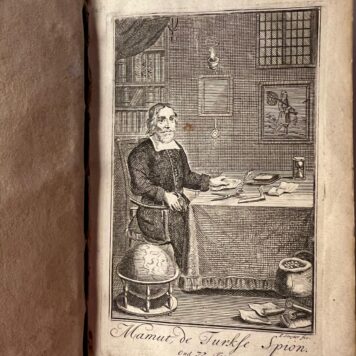
Full titlepage: Brieven, geschreeven door een Turkse spion, hebbende 45 jaaren onbekend tot Parys geleeft en huys gehouden. Waar in hy een onpartydig verhaal aan den Raad tot Konstantinopolen doet van het aanmerkelykste, in Europa voorgevallen, ontdekkende veele listen en geheymen van der Christenen Hoven, dog voornamentlyk van dat van Vrankryk, beginnende met het jaar 1637 en eyndigende met dat van 1682. Uyt het Engels vertaald door H.G. [= Hiddo Grettinga, Friese jurist en vertaler]. With frontispiece by P. Sluyter: Mamut, de Turkse Spion oud 72 jaaren. With mamut sitting in a study with books in the back and a globe in the front.
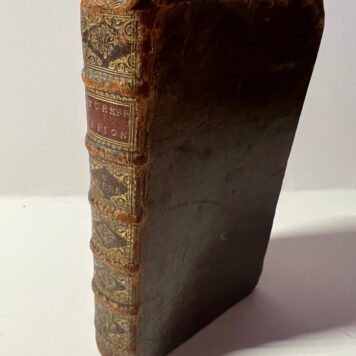
Full leather binding with some wear on the extremities. Decorated spine with gilt text: Turkse Spion V deel. Octavo edition, in -8, 16,5 x 10 cm. A tear in page 197/198. Some pages with browing and stains, others very good. Collation: π2 2π1 A-Z8
[NL] Ottomaanse spion die 45 jaar incognito in Parijs verblijft, literaire fictie van de uit Genua afkomstige Italiaanse schrijver Giovanni Paolo Marana en later (vanaf deel 2 door William Bradshaw). Hiddo Grettinga was getrouwd met Helena Knoop. Mooie manier om maatschappijkritiek te leveren: de fictieve Turkse spion Mahmut rapporteert aan de Divan in Constantinopel (nu Istanbul) over de Europese vorstenhoven. Daardoor konden gevoelige politieke onderwerpen behandeld worden. Met opdracht aan Anthony Heinsius, de mecenas van Grettinga.
Brieven van een Turkse Spion geldt als een van de vroegste en belangrijkste voorbeelden van de epistolaire roman (roman in briefvorm). Het werk oefende grote invloed uit op latere schrijvers, onder wie Montesquieu Lettres persanes
SKU: 110854
€ 136,25(€ 125,00







![[Antique engraving, 1598] Portrait of theologian Abel Bede (1568-1607), published 1598, 1 p.](https://arinevandersteur.nl/wp-content/uploads/WhatsApp-Image-2022-10-10-at-8.49.03-PM-356x356.jpeg)
![[Antique engraving, 1598] Portrait of theologian Abel Bede (1568-1607), published 1598, 1 p.](https://arinevandersteur.nl/wp-content/uploads/WhatsApp-Image-2022-10-10-at-8.51.02-PM-356x356.jpeg)
![[Antique etching, 1610] Houtewael by Amsterdam, [Views of Amsterdam; Series title], S. Frisius, published 1610, 1 p.](https://arinevandersteur.nl/wp-content/uploads/WhatsApp-Image-2022-10-17-at-19.59.09-356x356.jpeg)
![[Antique etching, 1610] Houtewael by Amsterdam, [Views of Amsterdam; Series title], S. Frisius, published 1610, 1 p.](https://arinevandersteur.nl/wp-content/uploads/WhatsApp-Image-2022-10-17-at-20.00.13-356x356.jpeg)
![[Antique engraving, ca 1562] LA MADRE E 'L RE' DI LAGRIME SI BAGNANO COL POPOL SUO ... [Set title: The fable of Cupid and Psyche], published before 1562, 1 p.](https://arinevandersteur.nl/wp-content/uploads/WhatsApp-Image-2022-10-18-at-10.32.54-PM-356x356.jpeg)
![[Antique engraving, ca 1562] LA MADRE E 'L RE' DI LAGRIME SI BAGNANO COL POPOL SUO ... [Set title: The fable of Cupid and Psyche], published before 1562, 1 p.](https://arinevandersteur.nl/wp-content/uploads/WhatsApp-Image-2022-10-18-at-10.34.32-PM-356x356.jpeg)
![[Antique etching, 1629] Landscape with large city gate on left and river on right [Topographia variarum regionum; Serie title], published before 1629, S. Frisius, 1 p.](https://arinevandersteur.nl/wp-content/uploads/WhatsApp-Image-2022-10-17-at-20.17.02-356x356.jpeg)
![[Antique etching, 1629] Landscape with large city gate on left and river on right [Topographia variarum regionum; Serie title], published before 1629, S. Frisius, 1 p.](https://arinevandersteur.nl/wp-content/uploads/WhatsApp-Image-2022-10-17-at-20.15.09-356x356.jpeg)

